
Despite navigating one of the largest oil shocks in history, renewed concerns over AI returns, and rising interest-rate expectations, U.S. equities delivered their strongest quarterly advance since 2020. Amidst the volatility, fixed income was also able to eke out a small gain. Portfolio Managers Anthony Brooks and David Siegel, CFA, summarize the litany of Q2 developments and what investors can prepare for in the 2nd half of the year.
Equity Overview
STRONG EARNINGS HELP MARKETS SPEED AROUND POTHOLES
Despite navigating one of the largest oil shocks in history, renewed concerns over AI returns, and rising interest-rate expectations, U.S. equities delivered their strongest quarterly advance since 2020. Resilient corporate earnings, continued AI infrastructure investment, and a solid economic backdrop helped investors steer around these obstacles, pushing the S&P 500 and Nasdaq Composite to their best quarterly performance in six years.
MEMORY STOCKS RACED FORWARD, THE MAG 7 HIT SPEED BUMPS
Artificial intelligence remained the market’s fastest lane, though leadership evolved beneath the surface. Semiconductor and memory companies dramatically outperformed as hyperscalers continued investing aggressively in compute infrastructure. Meanwhile, several Magnificent Seven stocks lost momentum as investors questioned whether extraordinary AI spending would ultimately generate equally extraordinary returns.
NEW FED CHAIR LEAVES PARKING BRAKE ON RATE POLICY
Economic data continued to point toward a resilient U.S. economy, with healthy payroll growth, steady consumer spending, and another quarter of solid business activity. However, inflation remained stubbornly above the Federal Reserve’s target, prompting new Fed Chair Kevin Warsh to strike a more hawkish tone than many investors anticipated. Expectations shifted from future rate cuts toward the possibility of additional tightening, though equities largely looked through higher rates as corporate fundamentals remained strong.
EARNINGS TRACTION HELPED ON WINDING ROAD OF GEOPOLITICS
While developments in the Middle East dominated headlines for much of the quarter, markets proved remarkably resilient. A ceasefire between the U.S. and Iran, the reopening of the Strait of Hormuz, and easing energy prices helped reduce one of the market’s largest macro risks. Meanwhile, first-quarter earnings growth approached 30%—its strongest pace in more than four years—providing investors with the confidence to remain focused on fundamentals rather than geopolitical uncertainty.
Market Outlook
CHECK FOR BLIND SPOTS AS AI TRAFFIC CONTINUES TO BUILD
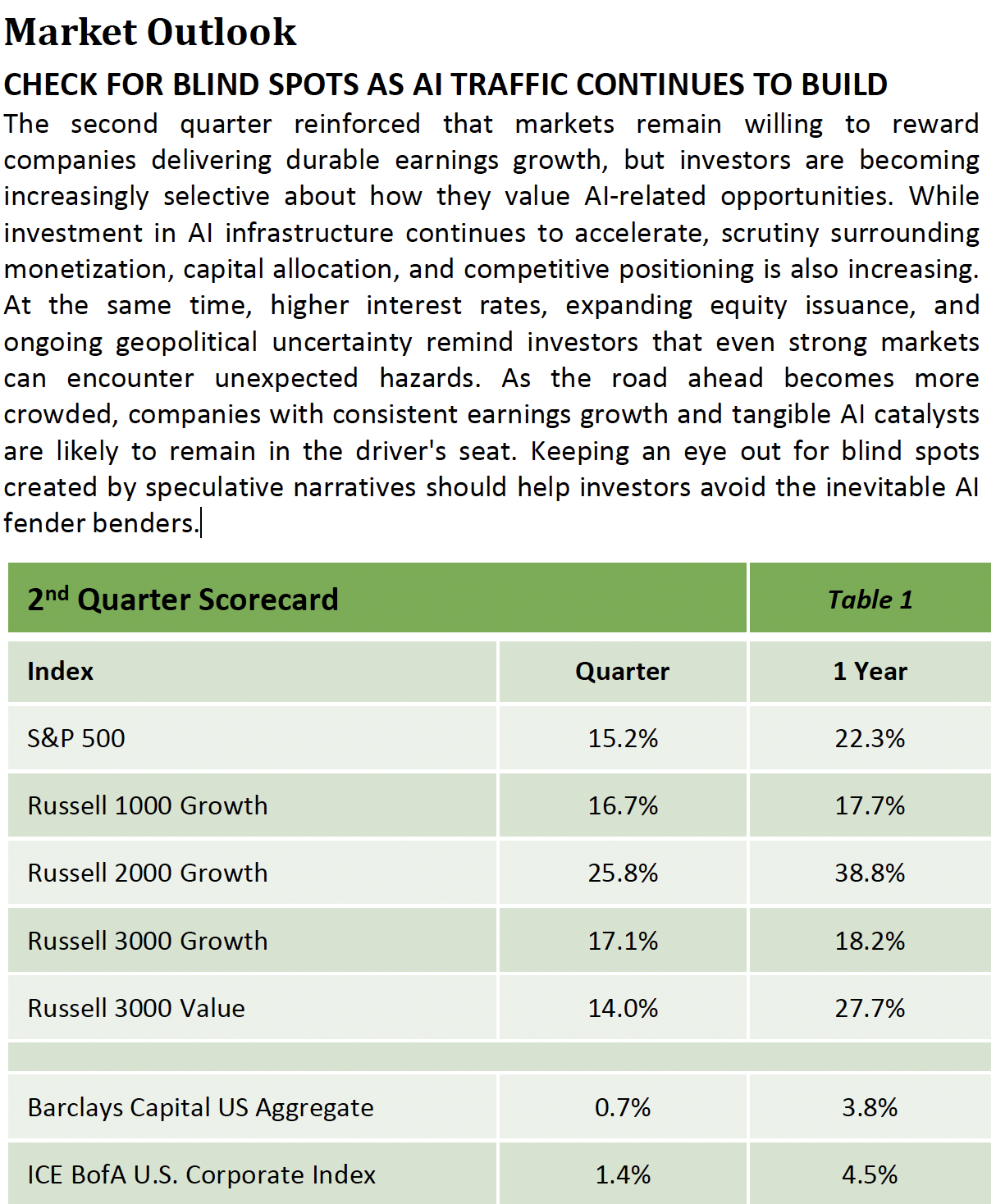
The second quarter reinforced that markets remain willing to reward companies delivering durable earnings growth, but investors are becoming increasingly selective about how they value AI-related opportunities. While investment in AI infrastructure continues to accelerate, scrutiny surrounding monetization, capital allocation, and competitive positioning is also increasing. At the same time, higher interest rates, expanding equity issuance, and ongoing geopolitical uncertainty remind investors that even strong markets can encounter unexpected hazards. As the road ahead becomes more crowded, companies with consistent earnings growth and tangible AI catalysts are likely to remain in the driver’s seat. Keeping an eye out for blind spots created by speculative narratives should help investors avoid the inevitable AI fender benders.
Fixed Income Overview
The volatility that began towards the end of the first quarter only continued throughout the second quarter, mainly driven by the ongoing war with Iran and concerns about the potential for long-term inflation. Hopes for de-escalation, including the signing of a 60-day memorandum of understanding on June 17th, helped to ease some of these concerns and resulted in a bit of retracing in interest rates. Despite the volatility, the Bloomberg Aggregate was able to generate a positive return of 0.67% for the quarter.
The 2-year, 10-year and 30-year were up 38bps, 15bps and 4bps respectively. Inflation concerns, along with a resilient labor market (chart 1), caused a further repricing in the expectation of Fed movements. Throughout the quarter, the pricing of rate movements went from close to no change up to pricing in approximately 1.5 rate hikes (chart 2).
Corporate bond new issue supply continued to run at a record-setting pace, with many of the hyperscaler technology companies announcing large global bond deals to fund further AI infrastructure. Elevated yields and resilient corporate fundamentals kept investor demand high, which led to spreads compressing by 14bps in the quarter. Overall, spreads are at historical tights and continue to price in a low default environment and strong economy.
A new chair of the Federal Reserve was named, with Kevin Warsh officially taking over for Jerome Powell on May 22nd for a four-year term. The market has not had a significant reaction to the appointment of Fed Chair Warsh, with his main policy differences expected to be the elimination of forward guidance, a reduction in the Fed’s balance sheet, and reviewing the Fed’s measurement of inflation.
Although an MOU was signed between the United States and Iran, it remains unclear what the eventual resolution will be between the countries and what the impact, both short-term and long-term, will be to the global economy. Further escalation could again upend the global energy supply and lead to more uncertainty. Even given the resiliency of the labor market, there have been signs of weakness in certain segments of the fixed income market such as private credit. With attractive yields amidst ongoing volatility, high-quality fixed income continues to represent a good opportunity given risk/reward.
The opinions expressed herein are subject to change. No content published here constitutes a recommendation of any particular investment, security, a portfolio of securities, transaction, or investment strategy. To the extent any of the content published may be deemed to be investment advice, such information is impersonal and not tailored to the investment needs of any specific person. Consult your advisor about what is best for you.
