AI anxiety and geopolitical turmoil led to a quarter full of volatility across all asset classes in the 1st quarter. Despite the ongoing war with Iran and fears about AI displacement, earnings remained steady and provided a stabilizing force amidst the uncertainty. Anthony Brooks and David Siegel, CFA, review how the markets have reacted so far in 2026 and provide an outlook for future implications.
Equity Overview
ENERGY SHOCKS CAUSE BROADER MARKET TO RUN OUT OF GAS
US equities pulled back in Q1 2026, with the S&P 500 ending a three-quarter winning streak amid notable weakness in big tech and software. Beneath the surface, rotation was evident as the equal-weight S&P held roughly flat and small caps posted modest gains, signaling continued market broadening. Energy stood out as the top performer on a surge in crude prices tied to geopolitical tensions, while cyclicals like materials and industrials also outperformed.
AI ANXIETY UNDERMINES TECH AS “DISRUPTION” DEBATE EVOLVES
The dominant equity narrative centered on growing skepticism around AI-driven returns. Software and large-cap tech names bore the brunt of this shift, as investors questioned whether massive capital expenditures would translate into sustainable profits. Fears of AI displacement—once theoretical—began to feel more tangible, pressuring valuations across the space and spilling over into private credit markets with exposure to tech.
GEOPOLITICS AND RATES COLLIDE TO RESET EXPECTATIONS
Markets entered the year balancing resilient economic data with expectations for multiple Fed rate cuts, but that narrative unraveled quickly. Escalating conflict in the Middle East—most notably the disruption of the Strait of Hormuz—sent oil prices sharply higher and reignited inflation concerns. As a result, expectations for rate cuts evaporated, with markets even briefly pricing in the possibility of hikes.
EARNINGS REMAIN A STEADY HAND AMID MACRO TURBULENCE
While macro uncertainty dominated headlines, corporate fundamentals remained relatively firm. Expectations for another quarter of double-digit earnings growth helped anchor sentiment, even as the market became less forgiving of high valuations and aggressive spending plans. The ongoing “K-shaped” dynamic persisted, with higher-income consumers supporting demand while pockets of weakness emerged elsewhere. Ultimately, earnings continued to provide a stabilizing force, though no longer strong enough to fully offset mounting geopolitical and policy risks.
Market Outlook
ROTATION OVER RETREAT AS MARKETS REACH FOR RETURNS
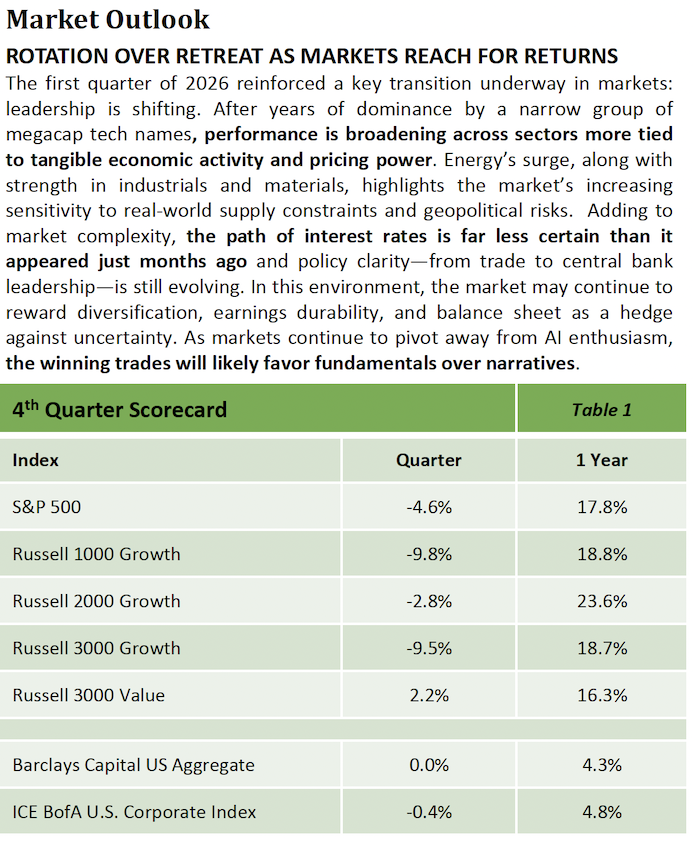
The first quarter of 2026 reinforced a key transition underway in markets: leadership is shifting. After years of dominance by a narrow group of megacap tech names, performance is broadening across sectors more tied to tangible economic activity and pricing power. Energy’s surge, along with strength in industrials and materials, highlights the market’s increasing sensitivity to real-world supply constraints and geopolitical risks. Adding to market complexity, the path of interest rates is far less certain than it appeared just months ago and policy clarity—from trade to central bank leadership—is still evolving. In this environment, the market may continue to reward diversification, earnings durability, and balance sheet as a hedge against uncertainty. As markets continue to pivot away from AI enthusiasm, the winning trades will likely favor fundamentals over narratives.
Fixed Income Overview
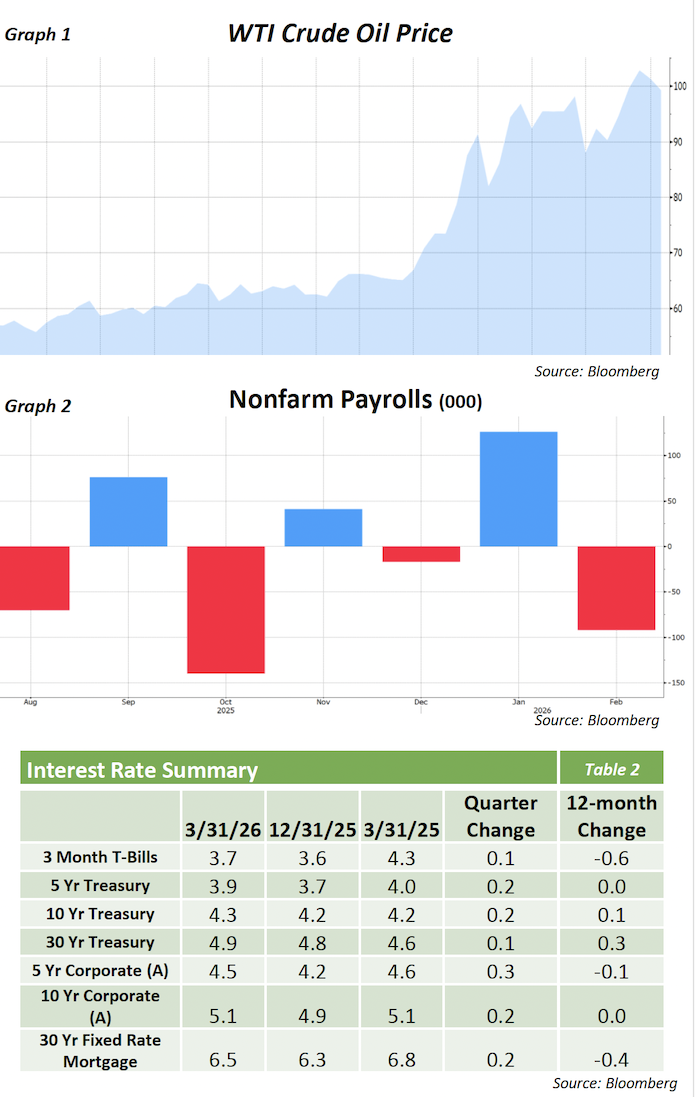
The beginning of the year started off as a continuation from the previous quarter, with signs of ebbing inflation and labor market cracks leading to expected rate cuts later in the year, and bond yields trending downward in response. However, these assumptions were all turned on their heads upon the U.S. striking military targets in Iran on February 28th. The subsequent bombings and closing of the Strait of Hormuz caused oil prices to spike by 80% YTD (graph 1). The resulting increase in yields caused intra-quarter volatility but, despite a February return of -1.8%, the Bloomberg Aggregate still managed to end the quarter down only -0.05%.
The 2-year, 10-year and 30-year U.S. Treasury were up 32bps, 15bps and 7bps respectively. Inflation concerns caused a repricing in expectation of Fed movements, which moved from pricing in two cuts throughout 2026 to the possibility of rate hikes during the year. Downward trending job growth (graph 2), along with the negative impact that high energy prices could have on consumer sentiment, had investors starting to utter the dreaded word of Stagflation.
Despite the risk-off and inflation worries, investors viewed investment grade corporate bonds as a bit of a safe-haven compared to other risk assets. While spreads widened by 11bps, the volatility was minimal in comparison. High-yield corporate bond spreads widened out by 47bps, and various private credit funds locked up liquidity for their investors and substantially marked down some of their positions.
Mortgage-backed securities started off the year strong as it was announced that Fannie Mae and Freddie Mac would be purchasing $200bn of mortgages, with the intention of lowering mortgage rates for consumers. However, the interest rate volatility and lack of details on the purchase program, eroded some of these gains throughout the quarter.
Geopolitical events are very difficult to predict and the length and impact of the current war with Iran are still very much unknown. A prolonged war could upend the global energy supply chain and have both near-term and long-term effects on the economy. A resolution should ease some of the tensions but, even in that scenario, the impacts remain unknown and can lead to more uncertainty. It is that type of environment where high-quality assets tend to outperform, and Sawgrass will continue to focus on locating opportunities and serving as a stabilizing force in client portfolios.
Opinions expressed herein are subject to change.